

-
 Back to top
 -
 021-65988999
 -
 QR code



Shanghai Hongguan Stainless Steel provides high-end steel products, and Monel 400 alloy is widely used by ship and factory engineers to manufacture pump shafts, seawater pipelines, and hydrofluoric acid treatment equipment due to its strength and high corrosion resistance. By understanding its chemical composition, one can understand why it can perform so well in harsh environments. This alloy is mainly composed of nickel and copper, and also contains trace amounts of iron, manganese, carbon, and silicon. It has strong corrosion resistance to seawater, acid, and alkali, while many other materials will fail in these environments. This guide provides a clear and practical introduction to the Monel 400 alloy, covering its chemical composition, main mechanical properties, hardness, density, and applications in various industries. It enables engineers and procurement personnel to evaluate its suitability without requiring too much detail.
What is Monel 400 alloy?
Monel 400 alloy is a high-performance nickel copper alloy that plays a key role in the field of materials science, especially suitable for scenarios that require extreme corrosion resistance and mechanical durability. This alloy was developed and produced in the early 20th century, characterized by its solid solution structure, which gives it unique strength and ductility over a wide temperature range. Its chemical composition is mainly composed of 63% -70% nickel and 28% -34% copper, which can maintain structural integrity in environments that quickly cause standard stainless steel or carbon steel to fail.
Chemical composition details of Monel 400 alloy
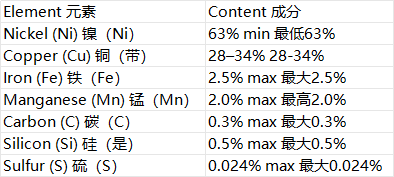
The chemical composition of Monel 400 alloy is very simple; Nickel and copper constitute its main components, while the other elements are controlled trace elements.
Why does nickel copper dominate
The high nickel content (at least 63%) ensures that the material has toughness and corrosion resistance over a wide pH range. Adding copper is to enhance the performance of the alloy in reducing environments such as sulfuric acid and seawater. This specific ratio enables the material to remain stable over a wide temperature range.
Trace elements and their effects
The iron content is controlled below 2.5% to ensure corrosion resistance, while manganese plays a role in deoxidation and improving ductility. The carbon content is controlled below 0.3% (according to ASTM B127 standard) to reduce the formation of carbides during welding and maintain corrosion resistance. The content of silicon and sulfur is also strictly controlled to ensure good surface smoothness and welding performance, thereby achieving stable and consistent performance of different batches of products.
Analysis of Mechanical Properties of Monel 400 Alloy
The mechanical properties of Monel 400 alloy vary depending on whether it is in an annealed or cold worked state. Both of these states have applications, but they have different purposes.

Tensile strength and yield strength
In the annealed state, the tensile strength is approximately 70000 to 80000 pounds per square inch, and the yield strength is approximately 25000 to 35000 pounds per square inch. Cold processing can significantly improve yield strength and is suitable for situations that require higher pressure levels or load-bearing performance. Therefore, the pump shaft and valve stem are usually in cold working condition specifications.
Elongation and Ductility
The alloy has a high elongation rate (35% to 50% in annealed state), which means it can be formed without cracking. It can be cold formed, hot formed between 1700 and 2100 degrees Fahrenheit, and can also be machined. This flexibility is very practical in the manufacturing process, especially for complex components or parts with flanges.
Density and physical properties
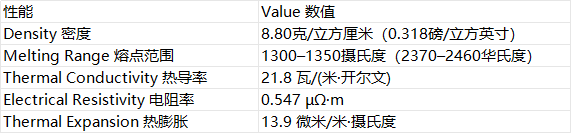
The density of Monel 400 alloy is 8.80 grams per cubic centimeter, higher than carbon steel (7.85 grams per cubic centimeter) and similar to stainless steel (approximately 8.0 grams per cubic centimeter). Personnel engaged in weight sensitive structural design should take this into consideration. Its melting range is quite wide, making it suitable for high-temperature applications such as steam generators.
The Best Application Scenarios of Monel 400 Alloy
This alloy can withstand low temperature conditions from minus 300 degrees Fahrenheit to a working temperature range of approximately 1000 degrees Fahrenheit in an oxidizing environment. The following are the main areas in which it is commonly designated for use.
Ocean and Saltwater Environment
The corrosion rate of Monel 400 alloy in seawater is extremely low, usually less than 1 mil/year, and it can resist biological attachment and cavitation damage. Offshore platforms use it for pump shafts, propeller shafts, fasteners, and seawater pipelines. This alloy can also resist stress corrosion cracking in chloride environments, which is the weakness of austenitic stainless steel.
Chemical processing industry
This alloy is one of the few materials that can maintain stability under hydrofluoric acid conditions (including concentrated and dilute acids). It can also be used in equipment for treating alkaline, neutral salt solutions, and some organic acids. In situations where the corrosion rate of 316 stainless steel is too fast, Monel 400 is a standard substitute material for equipment such as hydrogen fluoride alkylation units, acid pickling tanks, and reaction vessels.
Oil and gas applications
Suitable for acidic gas conditions, crude oil distillation, and downhole tool manufacturing. In environments containing hydrogen sulfide, valve internals, wellhead components, and tubing are common application scenarios. This material can be used for crude oil distillation towers and process equipment containing sulfides in refineries.
Monel 400 alloy products
Monel 400 alloy has multiple product forms, covering various products from profiles to precision fasteners. The following is a list of standard products and their typical uses for the production of Monel 400 alloy.
Monel 400 alloy pipe: This pipe is used for transporting corrosive chemicals and seawater in industrial pipeline systems.
Monel 400 alloy plate: a thick flat plate used for manufacturing large storage tanks, pressure vessels, and heat exchanger shells.
Monel 400 valve: This type of valve is crucial for controlling fluids in acidic or high salt environments without sticking.
Monel 400 instrument accessories: small connectors used for precision sensors and control systems.
Monel 400 bolts and nuts: heavy-duty fasteners that will not rust or break in marine or chemical environments.
Monel 400 double headed bolts and washers: used to secure flanges in high-pressure pipeline components.
Monel 400 profiles and angle steel: This structural profile is used to make support structures in corrosive environments.
Monel 400 screw: used as a small fastener in equipment assembly that requires corrosion resistance.
Monel 400 alloy tube: This product is commonly used in heat exchanger and condenser systems in power plants.
Monel 400 pipe fittings: elbows and tees are used to connect and change the direction of pipes.
Monel 400 coil and wire: used for manufacturing springs, mesh filters, and heating elements.
Monel 400 Ring: A circular sheet metal cutting piece used for end caps or specialized machined parts.
Monel 400 forged pipe fittings: The forging process can produce high-strength components, which are very suitable for high-pressure scenarios.
Monel 400 flange: used to connect pipe sections or connect pipelines with valves and pumps.
Monel 400 rod: a solid round or hexagonal rod used for processing shafts and other hardware components.
Monel 400 fastener: a universal category for all hardware that secures all corrosion systems together.
Monel 400 welding rod: a welding rod designed specifically for welding Monel 400 with itself or other metals.
Monel 400 gasket: used to form a tight seal between flanges in corrosive fluid systems.
summary
Monel 400 alloy occupies a place in material selection because this nickel copper alloy can indeed perform excellently in environments that ordinary alternative materials cannot handle. Its mechanical properties are stable and well documented, and its density and thermal data are reliable. Its application performance in the fields of ocean, chemical engineering, and oil and gas has long been verified. If using Monel 400 alloy for critical applications, please select according to current ASTM standards (B127, B164, B165) and purchase from certified suppliers who can provide material testing reports. Before finalizing the brand selection, please refer to the material specifications to match specific application requirements.
Related Recommendations
Shanghai Hongguan special alloy's Monel alloy is suitable for harsh working conditions such as marine systems and chemical plants ..
Stainless steel performs well in many working conditions, but its performance may be inferior in seawater or acidic environments ..
Shanghai Hongguan Stainless Steel Products provides various products of Monel alloy. Monel alloy pipes are widely used for corrosion ..
Shanghai Hongguan Stainless Steel provides high-end steel products, while Monel 400 alloy relies on its strength and high corrosion resistance ..

-
 Sales hotline: 021-65988999 65958588
 -
 Email: hongguansteel@163.com
 -
 Company Address: No. 3, Building 11, 6686 Songze Avenue, Qingpu District, Shanghai


